


Here’s what we learnt from an entire magazine devoted to ‘brand sounds’
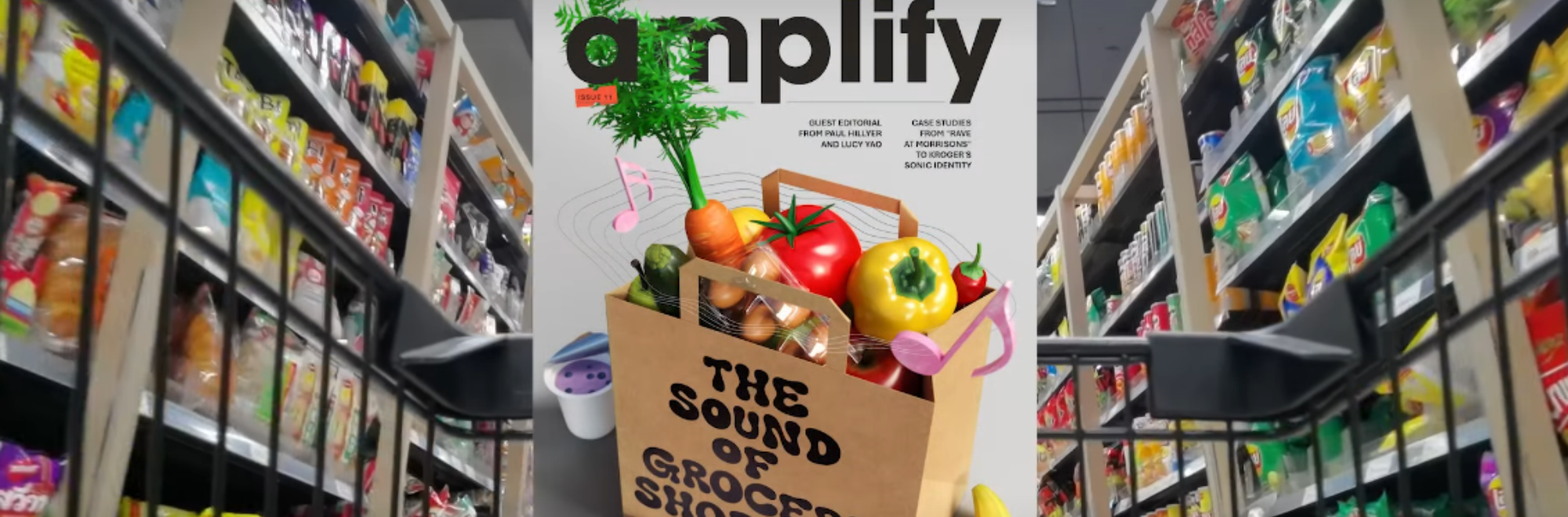
In a creative deep dive we didn’t see coming, it turns out brand sounds are a big deal, and there’s research to back it.
Marketers obsess a fair bit about visual distinctiveness: logos, colour palettes, typefaces, and all that good stuff. Brand sounds, however get a bit less love. And an annual publication from WPP-owned sonic branding specialist amp, has enlightened us about the virtues of audio in ads.
Now in its 11th edition, ‘The Sound of Grocery Shopping’ (yeah, it’s a thing) examines a world most marketers barely notice despite interacting with it every day: the music in supermarket ads, self-checkout beeps, app sounds, delivery notifications and in-store playlists.
Its central finding is that grocery retailers produce a huge amount of audio content, but very few appear to own any of it.
The supermarket sound problem
According to amp's analysis of 100 grocery brands worldwide, 63% of supermarket content relies on stock music. Only 31 brands have a sonic logo and just 15 use owned music.
The implication is that while many retailers are spending heavily on sound, they're often investing in music that belongs to somebody else.
The contrast becomes particularly striking when looking at the sector's strongest performers. Every one of the global top ten brands identified by amp has a sonic logo, while nine use owned music. The message is that the brands that perform best sonically don't simply use sound. They own it.
Why Aldi tops the UK but still has work to do
The UK rankings reveal an interesting contradiction. Aldi emerged as Britain's strongest sonic performer, ranking 32nd globally. Morrisons followed in 35th place, with Asda in 37th.
Further down the list came Lidl (45th), M&S Food (54th), Tesco (58th), Sainsbury's (68th), Ocado (76th), Waitrose (78th) and Co-op UK (86th).
On the surface, Aldi's performance looks impressive. Dig deeper and the picture becomes more complicated. Despite topping the UK rankings, Aldi deployed its sonic logo in just 1% of the content analysed.
Consistency matters more than creation
The report points to Kroger in the US as another example. Its "Doin' It Fresh" sonic branding system has been strategically developed, yet the sonic logo appears in only 34% of content reviewed, while stock music still accounts for 37%.
In other words, a sonic asset gains value only when audiences repeatedly encounter it.
Christmas jingles
Perhaps the most intriguing section focuses on UK Christmas advertising. Every year Britain's supermarkets battle to own Christmas through cinematic storytelling and emotional music choices. Yet amp's research suggests most are building emotional resonance for songs rather than brands.
Almost every UK supermarket analysed used licensed music in its 2025 Christmas campaign, but only one retailer fully integrated its sonic branding.
Morrisons adapted its sonic logo to fit the vocal style of Jona Lewie's Stop the Cavalry, weaving its own distinctive audio identity into the campaign rather than treating music and branding as separate elements.
Asda also nodded towards ownership by incorporating its familiar pocket-tap gesture alongside festive sleigh bells.
The wider takeaway is less comfortable for marketers. If consumers leave remembering the song but not the brand's own sonic cues, who really benefits from the investment?
The report effectively poses the question: are supermarkets spending millions to build emotional connections with musicians instead of themselves?
Discount retailers understand the long game
Another unexpected finding concerns discount supermarkets. Conventional wisdom might suggest premium retailers outperform value brands when it comes to carefully managed brand systems. The research suggests the opposite may be true in audio.
Discount grocery brands use owned music in around 4.5% of content compared with roughly 1% among premium grocers. Nearly three times as many discount retailers have sonic logos.
Those sonic identities are also significantly older. The average discount retailer sonic logo has existed for approximately 15 years, compared with just 4.5 years for premium brands.
It's a finding that echoes what marketers often discover about brand-building more generally: distinctiveness is frequently less about sophistication than repetition.
The world's top-ranked grocery brand, Mexico's Chedraui, offers a perfect demonstration. Its sonic logo is more than 25 years old and appears in 78% of content, while owned music appears in 45%.
That level of consistency creates memory in consumers that are difficult for competitors to imitate.
The magazine might be unusual then, but what seems clear is that many brands are still leaving one of their most distinctive assets sitting silently on the shelf.
If you enjoyed this article, you can subscribe for free to our weekly email alert and receive a regular curation of the best creative campaigns by creatives themselves.
Published on: