


Turning Pakistan's walls into a conversation about violence against women
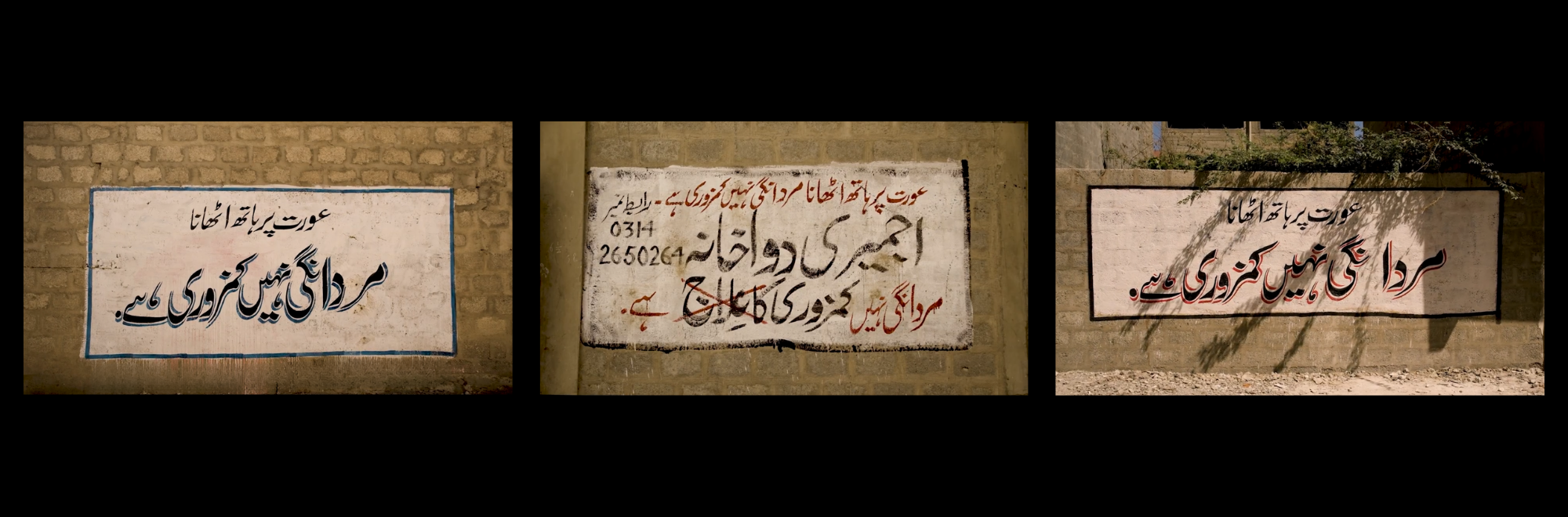
Asma Humayun, filmmaker and founder of Shiny Toy Guns, shares the story behind the work that used familiar hand-painted ads to illustrate how violence is a weakness, not a strength.
I grew up in Pakistan, a country rich in culture, history and resilience, but also one where many women learn from a very early age how deeply patriarchy shapes everyday life. We grow up absorbing messages about what it means to be a "man" and what it means to be a "woman".
These messages are everywhere: in films where aggression is romanticised, in television where controlling behaviour is normalised, in the advertisements painted on the walls we pass every day, in dinner table conversations, and in the invisible rules society quietly places on women before they are even old enough to notice them.
Toxic masculinity is not unique to Pakistan. It is a global inheritance.
Across the world, women continue to experience domestic violence and abuse, and tragically, many lose their lives to behaviours rooted in control, entitlement and the belief that violence is proof of power.
In Pakistan, about 28% of women aged 15–49 have experienced physical violence, while 6% have also faced sexual violence. Among ever-married women, one in three has experienced physical, sexual or emotional violence by a spouse, according to the Pakistan Demographic and Health Survey 2017-18. These are not abstractions. They are neighbours, cousins, friends. Sometimes, they are us.
As creatives, I believe we carry a responsibility to challenge the narratives that shape society.
Creativity is not only a tool for selling products; it can question, disrupt and, if we are brave enough, create change.
For Women's History Month back in 2021, working with UN Women Pakistan and IMPACT BBDO, we set out to confront one of the most damaging ideas surrounding masculinity: that violence is a sign of strength.
The result was Mardana Kamzori ("male weakness"), a public wall intervention and film that transformed local advertisements for male strength into a bold statement against toxic masculinity. Told through the voices of everyday people, the campaign challenged abuse and misogyny for what they truly are: weakness, not masculinity.
The wall was already there. We just changed what it said.
Anyone who has walked through a Pakistani city knows these walls.
Hand-painted advertisements promising remedies for "Mardana Taqat", or male strength, are everywhere. The phrase is often used as a euphemism for male potency and masculinity. These walls are part of the visual landscape of the country, seen by millions of men on their way to work, to the market and through everyday life.
Nobody questions them. They simply exist, the way certain ideas about masculinity simply exist: quietly accepted and rarely examined.
We saw an opportunity hidden in plain sight. What if we took the language men already knew by heart and turned it against violence instead of in service of it?
Using the same hand-painted style and the same street-corner language, we hijacked the walls and changed their meaning completely. Where they once promised ideas of male potency and strength, they now delivered a verdict.
The message was simple: hitting a woman is male weakness
One line was enough to flip a phrase built on male insecurity into a public reckoning with abuse. We did not argue with tradition or shout over it. We simply took its own vocabulary and turned it to face the truth: violence is not power, authority or masculinity. It is the clearest evidence of weakness there is.
We did not have a large media budget. We had walls, words and a conviction that ideas, placed in the right hands, in the right language and on the right street corner, can move people further than money ever could.
The campaign sparked conversations across the country, turning something people had walked past for years into something they could no longer ignore.
Why this one stayed with me
This project was never just a campaign for me. As a woman, as a filmmaker and as someone who grew up witnessing the impact of patriarchal systems on women over generations, this was personal in a way few projects are.
It reminded me that change rarely begins with a grand gesture. It begins when someone dares to question the things everyone else has silently agreed to accept.
We cannot rewrite culture overnight, but we can rewrite the stories that hold it up, one wall, one word and one uncomfortable truth at a time. And sometimes, if you choose the right language and say it in the right place, a wall can become a voice.
If you enjoyed this article, you can subscribe for free to our weekly email alert and receive a regular curation of the best creative campaigns by creatives themselves.
Published on: