


AI at the Super Bowl: The psychology of surrender
AI is everywhere. At work. At home. In places we don’t see.
Its expansion has generated a discourse of worry so widespread that even advertisements are compelled to address it. Nowhere was this tension more theatrically staged than the 2026 Super Bowl.
While the half-time spectacle delivered its own political and cultural charge (more on that here), the supporting advertisements told a subtler story. From personified AI horrors to aggressive nostalgia, the 2026 Super Bowl was a diary of mass confusion and tantalising resistance.
Let’s unpack.
Alexa+ (Alexa Plus): Surrender through convenience
What’s worse than AI? AI that’s self-aware.
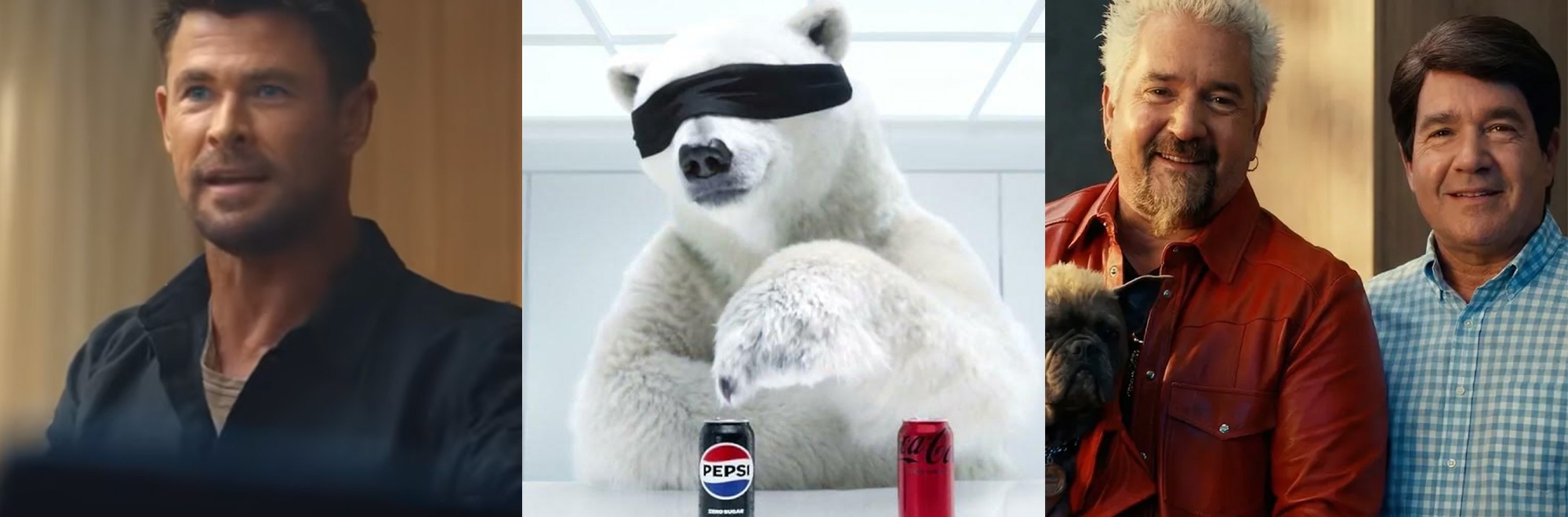
Amazon showcased its new next-gen Alexa Plus and its more playful and conversational upgrade by satirically ‘torturing’ actor Chris Hemsworth in various ways. Upon seeing the new device in his home, Chris expresses immediate concern and asks his wife to remove it, claiming, “That’s full-on AI...one minute we’re all buddy-buddy, and the next minute she’s trying to kill us”.
The ad features Chris imagining AI-fuelled tragedies, like being drowned in a pool, blown up in a gas fire, killed by a bear…and ends with Alexa offering a massage to remedy such a stressful experience – to which Chris readily accepts.
Amazon cleverly plays on concerns while anchoring the message in human truth: most of us fear AI and its potential, until we resign in the name of convenience.
This is an important lesson for brands moving forward: address problems not with solutions but enticing distractions; don’t look to neutralise fear, but utilise it. A message that the next ad by Bosch encapsulates perfectly.
Bosch: Resistance through identity
While Alexa+ satirises our concerns of impending AI domination, Bosch takes us right back to a classic advertising formula: “If you buy X, you become Y”.
The ad shows Guy Fieri as plain and average, until he interacts with a Bosch appliance. Then he transforms into a person with edge – tattoos, bling, leathers. If you didn’t believe it could get any more cookie-cutter than that, even his dog features a similarly loud transformation.
Although the use of special effects is present, Bosch made a statement (link) proudly declaring its lack of AI usage in the ad. This stance from Bosch is particularly interesting because, like this ad, our standard household appliances are fundamentally the same as they were 20 years ago – an AI ad would not make sense as a result.
While the production of Bosch appliances may be elevated by AI, their everyday functionality still relies on human operation.
But Bosch is not selling resistance; it's selling an identity – it's giving the consumer hope that their own transformation is budding. Hope is the operative word here – in a world that feels uncertain and constantly changing, we naturally look closer at ourselves. A brand that excellently turns this self-awareness into a tribal brand warfare is Pepsi.
Pepsi: AI tribalism
Bosch sells identity as reassurance; Pepsi sells belonging as protection.
Pepsi’s ad makes every attempt to appeal to the many generations watching the Super Bowl. Like a kids' show making adult references, Pepsi picks up on key cultural moments – like the Coldplay concert cheating scandal – and uses AI polar bears (the mascot of Coca-Cola) to display a bear who becomes existential after realising it prefers the taste of Pepsi. The use of AI becomes almost hidden in the sea of cultural references.
While Amazon plays on unspoken fears and Bosch focuses on individual improvements, Pepsi is anchored in the collective experience.
There is nothing more tribal than coming after your direct competitor. Unsurprisingly, its campaign sparked a discourse online of people taking sides and choosing their teams, with one Reddit user suggesting that “Pepsi has just run circles around Coca-Cola with this ad”.
It’s a bold move from Pepsi, and one that Coca-Cola has not responded to – granted, it was already taking some heat for its controversial AI Christmas ad.
Conclusion
The crux of concern regarding AI is due to our uncertainties surrounding its possibilities. This uncertainty unsettles us, and without fully noticing, we gravitate towards the binary.
These brands are repeatedly inviting us to pick sides - convenience or none (Alexa), levelling up or staying plain (Bosch), and picking a favourite (Pepsi). In a world swimming with options, it seems we only have two: this or that.
Homing in on this dichotomy makes the consumer feel less overwhelmed, and more like they have chosen for themselves – the impression of agency is especially important in a time where AI automations can feel like they make a lot of our decisions for us.
The irony is palpable: as AI technology advances, brands narrow our options.
We are still circling the AI orbit, but at least consumers can feel like they have their feet on the ground. I’ll leave you with a closing thought: are we surrendering to AI, or are brands domesticating our responses to it?
All images courtesy of campaign footage.
If you enjoyed this article, you can subscribe for free to our weekly email alert and receive a regular curation of the best creative campaigns by creatives themselves.
Published on: