


Brilliant 2024 campaign reminds us of the impact of ‘show, don’t tell’
I’ve been helping my daughter revise for her GCSE mocks recently.
This has involved me explaining words I know, like juxtaposition, and learning some that were absolutely not on the 1996 exam syllabus, like litotes. You what now?
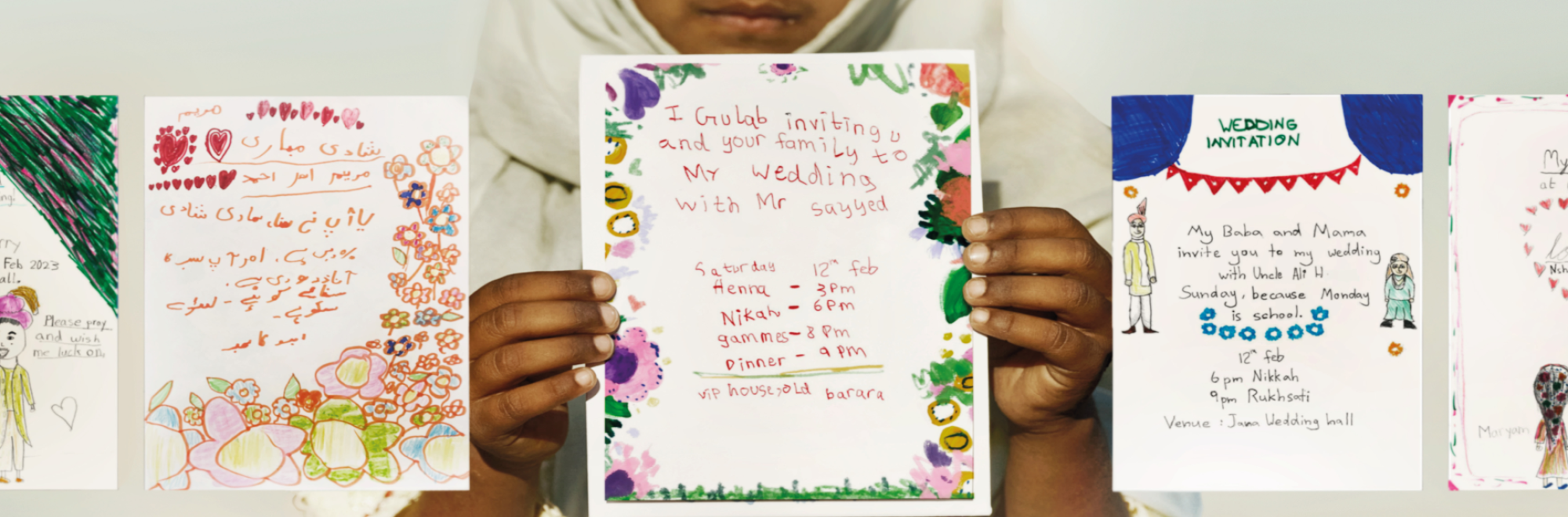
This 2024 UN Women campaign against ‘child marriage’ in Pakistan uses the power of contrast, so it's no surprise it especially stood out to me this week.
It centres on [fictional] wedding invitations drawn by children for ‘their own wedding’. These were sent to lawmakers, included in a campaign video and used to garner public support.
The simple but harrowing placement of a child’s drawing and a wedding invitation is what makes it such a jolting creative idea, and such an effective one.
Plus, I understand, an (always hand-delivered) wedding invitation also has a status in Pakistan that added even more to this work’s meaning.
All the reports, meetings and words in the world can’t be beaten by the simplicity of an image that hammers home what ‘child marriage’ really is (read the poem by Hollie Nash if you haven’t).
Rather than telling people why ‘child marriage’ is wrong, it makes them FEEL it.
I hate how often that quote “people will never forget how you made them feel” is taken for mundane presentations (and btw, apparently it’s also misattributed to Maya Angelou). But in this case, it’s true: once you’ve seen this campaign, you feel it and can’t forget it. It leaves you with a lingering sense of unease, but it does it so gently with the innocence of the art direction.
I love public affairs campaigns that also combine creativity and PR to generate public outcry for change, meaning politicians have to act. This is a perfect example of that.
Another thing I hate is how often people (usually men…sorry, not sorry) preface speaking out about inequality or violence against women and girls with, “As a parent of girls”, because it shouldn’t take a female family member to understand right and wrong.
However, I can’t deny, “as a parent of a girl”, there’s that juxtaposition of me seeing my daughter revise for her GCSEs, knowing if she lived in Pakistan, she could have been one of the '1 in 5 brides in Pakistan are under 18' statistic at the time of the campaign. This makes it a bit more raw.
I hadn’t seen the campaign when it first launched. Rightly, it had a lot of industry recognition. Most importantly (‘cos isn’t commercial, cultural or societal impact what we’re all here for, after all?), it created a law change in Pakistan, setting the minimum marriage age at 18.
Hats off (belatedly) to the team behind it, including Asma Humayun and team at Shiny Toy Guns, who Creative Moment spoke to just last month.
If you enjoyed this article, you can subscribe for free to our weekly email alert and receive a regular curation of the best creative campaigns by creatives themselves.
Published on: